
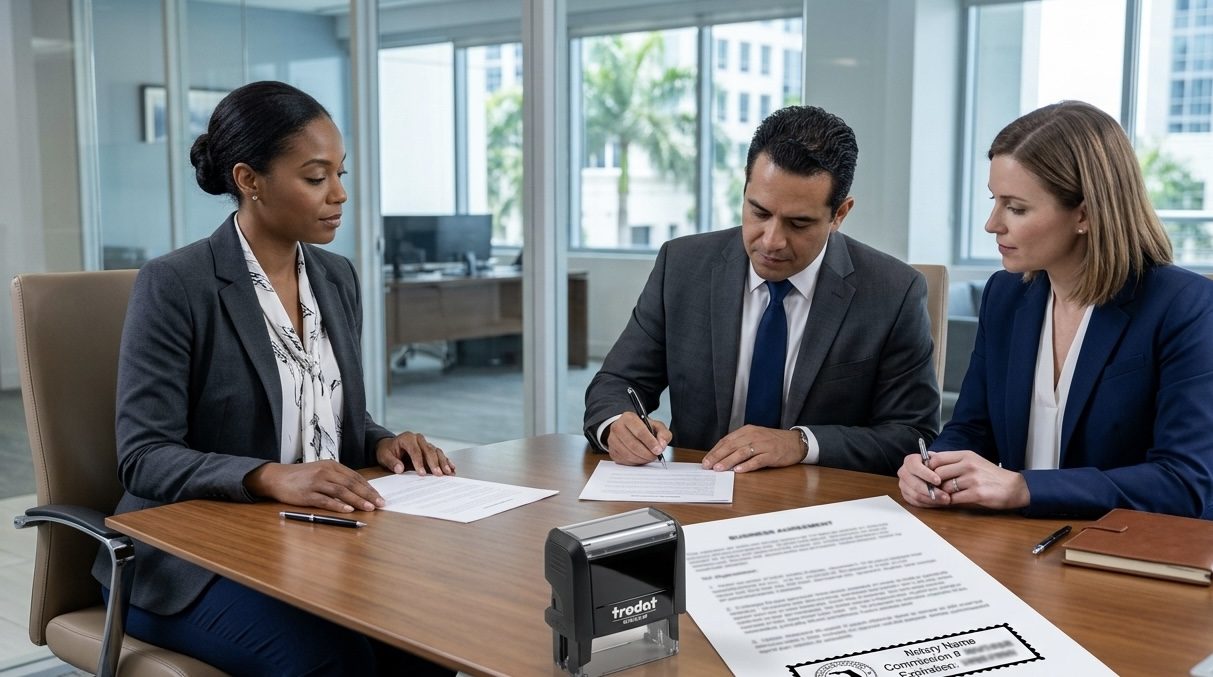
Florida has some of the most comprehensive notary laws in the United States — and understanding the basics can save you from costly mistakes, rejected documents, and unnecessary delays. Whether you are a resident needing a single document notarized or a business owner managing high-volume document authentication, this guide covers the key Florida notary rules you need to know.
Florida notaries public are commissioned by the Governor of Florida under Chapter 117 of the Florida Statutes. They are authorized to administer oaths, take acknowledgments, attest to photocopies of certain documents, and perform other official acts. A notary commission in Florida lasts four years and requires a $7,500 surety bond.
Florida notaries are not attorneys and cannot give legal advice about a document’s content. Their role is limited to official notarial acts — identifying the signer, confirming the signer is acting willingly, taking acknowledgments and oaths, certifying certain copies, and similar duties set out in Chapter 117. Asking a notary to advise on legal language is both improper and against Florida Statutes.
One of the most important things Florida residents need to understand is that a notary’s role is strictly procedural. They verify who you are — not what your document says. This distinction matters especially when preparing documents for apostille authentication or international use, where the content accuracy is entirely your responsibility.
Key Florida Notary Laws Every Resident Should Know:
- Signers must appear in person before the notary — or via approved Remote Online Notarization
- A notary must identify the signer through personal knowledge or satisfactory evidence — usually a government-issued ID that is current or was issued within the past five years and has a serial number, or sworn statements from credible witnesses
- A notary cannot notarize a document in which they have a direct financial interest
- A notary cannot notarize their own signature or the signature of their spouse, son, daughter, mother, or father
- Florida notaries may perform Remote Online Notarization (RON) under section 117.265, Florida Statutes
- Electronic notarizations are legally valid in Florida when performed on an approved RON platform
- A journal is not required for traditional paper notarizations in Florida but is strongly recommended; online notaries must keep an electronic journal and audio-video recordings for at least 10 years
- Notarized documents intended for international use must then be apostilled by the Florida Secretary of State
Remote Online Notarization — or RON — became permanently available in Florida in 2020, allowing Florida-commissioned notaries to notarize documents for clients located anywhere in the world via audio-visual technology. Our West Palm Beach office offers Florida-compliant RON services for clients who cannot appear in person, making it one of the most flexible and convenient options available to Palm Beach County residents and international clients alike.
What a Florida Notary Can Legally Charge
Florida caps notary fees by statute: no more than $10 for any one notarial act performed in person, and no more than $25 for an online notarial act. A notary may not charge anything for witnessing a vote-by-mail ballot, and a notary’s fee for performing a wedding may not exceed what the clerk of the circuit court may charge for the same service. If you book a mobile visit, ask how any travel charge is listed separately from the notary fee.
What ID to Bring Under s. 117.05(5)
A notary must either know you personally or have “satisfactory evidence” of who you are. Your ID must be current or issued within the past five years and carry a serial or other identifying number. The statute accepts:
- A Florida driver license or Florida ID card
- A U.S. passport
- A foreign passport, but only if stamped by U.S. Citizenship and Immigration Services
- A driver license or ID card from another state, a U.S. territory, Canada or Mexico
- A U.S. armed forces ID card or a VA veteran health identification card
- An identification card issued by USCIS
- Certain state and federal inmate ID cards
Without one of these, Florida allows sworn statements from credible witnesses: one witness the notary personally knows, or two witnesses whose identities the notary verifies. They must know you personally and have no financial interest in the transaction. For online notarization, unless the notary knows you, your ID goes through credential analysis plus identity proofing, and if either fails the notary cannot proceed. Full rules are in section 117.05, Florida Statutes.
When a Notary Must Say No
Section 117.107 bars a Florida notary from:
- Notarizing for the notary’s spouse, son, daughter, mother or father
- Notarizing when the notary has a financial interest in, or is a party to, the transaction (an employee may still notarize for an employer if the only benefit is salary and the notary fee)
- Notarizing a blank or incomplete document
- Notarizing for someone who appears mentally incapable of understanding the document
- Taking an acknowledgment from someone who does not speak or understand English, unless the document has been translated into a language the signer understands
If you will sign a document you cannot read, have it translated before your West Palm Beach appointment with our certified translation services.
Check the Notarial Certificate Before You Leave
Under s. 117.05(4), every Florida certificate must show the venue (State of Florida, County of ___), whether the act was “sworn” or “acknowledged,” whether you appeared in person or by audio-video, the date, your name, whether the notary knew you or what ID you showed, and the notary’s signature, printed name and seal. An acknowledgment cannot replace an oath when the document requires one.
This matters most for documents going abroad. The Florida Department of State requires a full notarial statement, in English, with the notary’s original signature, stamp and seal. A notary cannot amend a completed certificate, so a missing item usually means notarizing again. Whether the destination needs an apostille or a notarial certificate depends on the country; see our notarized document apostille page.
Journals Are Mandatory for Online Notarizations
An online notary must keep a secure electronic journal of each act, including the date and time, type of act, document description, each signer’s name and address, the fee and how identity was confirmed. The journal and the full audio-video recording must be kept for at least 10 years (s. 117.245).
Wills, Powers of Attorney and Deeds: Witness Rules
- Wills (s. 732.502): signed at the end by the testator before at least two attesting witnesses, who sign in front of the testator and each other. A self-proving affidavit before a notary (s. 732.503) lets the will be admitted to probate without further proof. See will notarization.
- Powers of attorney (s. 709.2105): signed by the principal and two subscribing witnesses, and acknowledged before a notary. See our power of attorney notary service.
- Deeds (s. 689.01 and s. 695.26): signed before two subscribing witnesses. For recording, each signer’s and witness’s printed name and post-office address must appear, the notary’s name must be printed beneath the notary’s signature, and a 3-by-3-inch space must be left at the top right of page one. More on deed notarization.
Online signings of wills, certain trusts, advance directives and many powers of attorney carry extra screening questions under s. 117.285. If the signer is a vulnerable adult, video witnesses do not count; witnesses must be physically present.
Notaries Can Perform Weddings
Florida notaries may solemnize marriages (s. 741.07), but must first require a marriage license issued under Florida law (s. 741.08). Obtain the license before the ceremony date.
Frequently Asked Questions
Can a notary notarize for my brother or grandmother?
The family restriction names only the spouse, son, daughter, mother and father. Other relatives are not listed, though the financial-interest rule still applies.
Can a notary certify a copy of my birth certificate?
No. Florida notaries cannot attest copies of vital records or of public records the custodian can copy, such as court filings, recorded documents and filed tax returns. Order a certified copy from the issuing agency.
Can someone who is blind or unable to sign get a document notarized?
Yes. The notary may notarize for a blind signer after reading the whole document aloud. A signer may sign with a mark before two disinterested witnesses. If a disabled person cannot sign or make a mark, the notary may sign at their direction before two disinterested witnesses, adding a notation under the signature.
Can I use Florida online notarization if I live outside Florida?
Yes. The online notary must be physically in Florida, but you can be elsewhere; the notary must confirm you want a Florida notary and Florida law to apply. Any remote witness must be located in the United States or a U.S. territory.
Written by Palm Beach County Apostille · Last updated October 14, 2026