
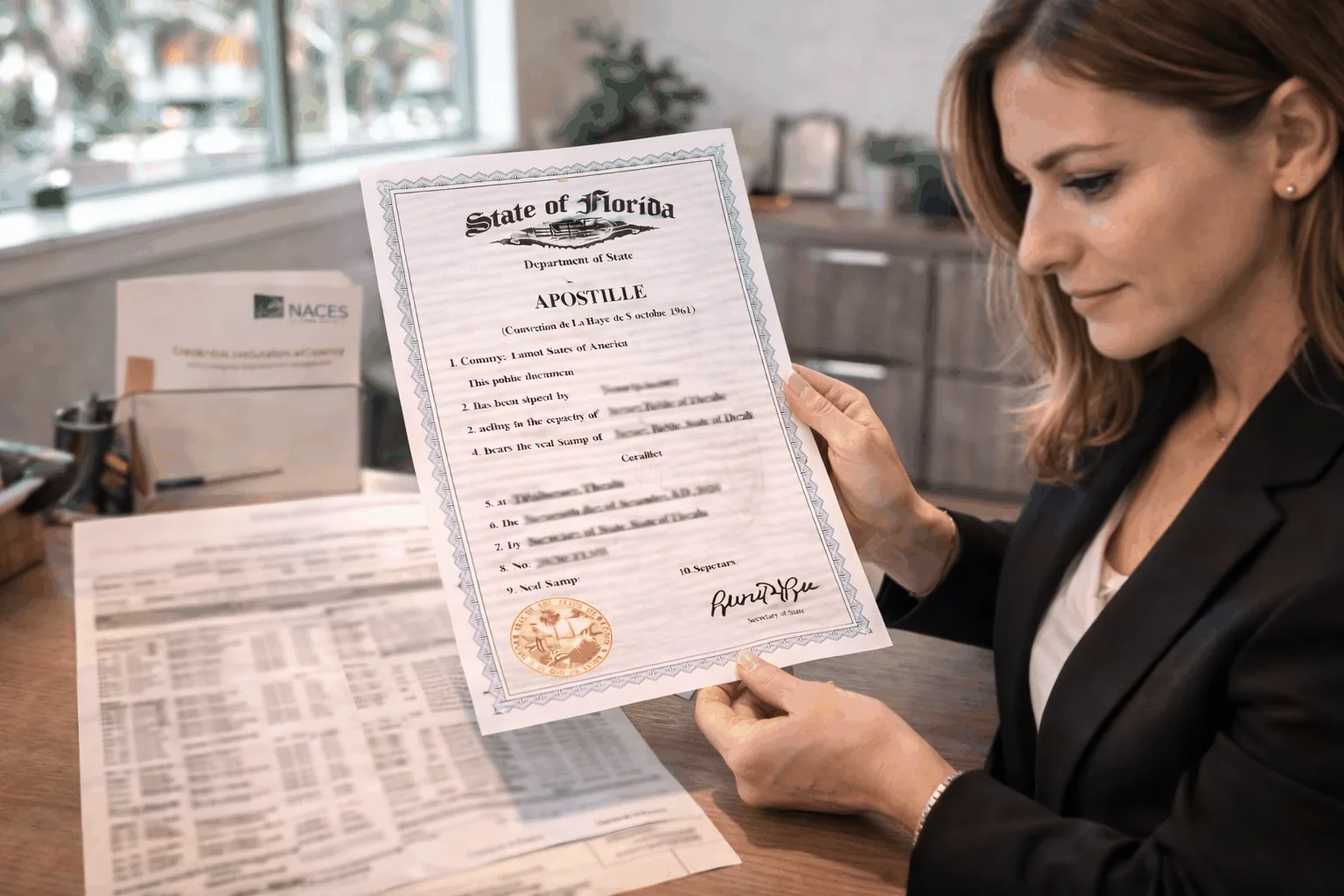
One of the most common questions we receive at our West Palm Beach office is: “Can my document be apostilled?” The answer depends on the document type, its origin, and whether it carries the proper signature or seal required by the Florida Secretary of State. This guide covers every major document category that qualifies for apostille authentication in Florida.
An apostille can only be placed on a public document — meaning a document that has been issued or certified by a government authority, notarized by a commissioned notary public, or authenticated by a state or federal agency. Private documents must first be notarized before they can receive an apostille.
Florida apostilles are issued exclusively by the Florida Secretary of State’s office. If your document was issued by a federal agency — such as the FBI or a federal court — it must be apostilled through the US Department of State in Washington, D.C., not through Florida.
Understanding which office handles your specific document is critical. Submitting a federal document to the Florida Secretary of State — or vice versa — will result in an automatic rejection and wasted processing time. Our West Palm Beach team identifies the correct submission path for every document type before we begin.
Most Commonly Apostilled Documents in Florida:
- Birth certificates issued by the Florida Department of Health
- Death certificates issued by the Florida Department of Health
- Marriage licenses and certificates issued by Florida county clerks
- Divorce decrees and final judgments issued by Florida courts
- Diplomas and academic transcripts — public-school records signed and notarized by the school registrar or issuing official; private-school records may be notarized copies
- Power of attorney documents notarized by a Florida notary public
- Corporate documents including articles of incorporation and certificates of good standing
- Affidavits and sworn statements notarized by a Florida notary public
- Adoption documents issued or notarized in Florida
- FBI background checks — processed through the US Department of State
The most important thing to remember is that the document must originate in Florida — or be notarized by a Florida-commissioned notary public — to be eligible for a Florida apostille. If your document was issued in another US state, it must be apostilled by that state’s Secretary of State office instead.
If you are unsure whether your specific document qualifies, bring it to your appointment at our West Palm Beach office or call us at (561) 475-4757. Our specialists will review it and advise you on the correct process — free of charge.
Document-by-Document: What the State Needs to See
A Florida apostille certifies the signature of the official or notary who signed your document. So for each document, the real question is whose signature is on it and whether the Florida Department of State can verify it. Here is how that works for the documents we handle most often in West Palm Beach. The Department of State’s list of accepted document types is the official reference.
Birth and death certificates
Order a certified copy from the Florida Bureau of Vital Statistics or a county health department. The state accepts certificates signed by the State Registrar and confirms that the signature was valid when the certificate was issued. The Bureau also has dedicated apostille applications for birth, death, marriage, dissolution of marriage and single-status records.
Florida issues birth certificates in two formats: a computer-generated certificate and a manually produced photocopy-generated certificate, which costs extra and takes longer. The Department of State notes that birth records before 2004 contain limited information, so ask the receiving country’s consulate or embassy which version it accepts before you order. More detail is on our birth certificate apostille page.
Marriage and divorce records
Marriage and dissolution of marriage certificates can come from the Bureau of Vital Statistics, signed by the State Registrar, or be signed by the county Clerk of Court. If the receiving office wants the full final judgment of divorce rather than the state’s dissolution certificate, request a certified copy from the Clerk of Court in the county that granted the divorce. Keep in mind that the state charges more for clerk-certified documents (see the FAQ below). Our divorce certificate apostille page covers both options.
Other court documents
Name-change orders, adoption judgments, probate orders and other circuit court records must be certified copies from the Clerk of Court. A notary cannot attest a copy of a document filed in a court proceeding or recorded by the Clerk, so a notarized photocopy of a court order will not qualify.
School transcripts and diplomas
For a Florida public school or university, the state wants a notarized transcript signed by the School Registrar or another issuing official, with a full notarial statement. For a private school, a printed transcript is notarized with a statement, signed by the student or the records custodian, attesting that it is a copy. Many universities handle this for you. Florida Atlantic University, for example, will notarize a requested transcript or diploma and send it to you so you can submit it for the apostille. See our transcript apostille page for the steps.
Corporate documents
For records of a Florida company, send the original certified copy or certificate of status issued by the Department of State. Photocopies are not accepted. If you don’t have one yet, you can order the certificate and the apostille together, paying each fee with a separate check or money order. Documents signed by company officers, such as resolutions, go through the notarized-document route instead.
Florida background checks
The state accepts Florida criminal background checks from FDLE and local law enforcement. With FDLE, choose the certified search: results from the online Instant Search are not certified, while certified search results can be notarized. Our state background check apostille page explains the process.
Documents Florida Cannot Apostille
- Federal documents, such as FBI background checks, federal court records and other documents signed by a federal official, go to the U.S. Department of State. Do not notarize an original federal document, because the State Department warns it will no longer be valid. Our FBI background check apostille page covers that process.
- Documents issued in another state, or signed by another state’s notary, go to that state’s competent authority.
- Notarized photocopies of public records won’t be accepted. Florida notaries cannot attest copies of birth, death or marriage certificates, certificates of citizenship or naturalization, filed tax returns, Florida professional licenses or student records kept in public education offices. Get a certified copy from the issuing office instead.
Common Reasons a Request Is Rejected
- Sending a photocopy instead of an original certified copy.
- A missing or incomplete notarial certificate. The state requires a full notarial statement in English, with the notary’s original signature, stamp and seal.
- A notary name, commission number or expiration date that doesn’t match the state’s notary database. These are the details Tallahassee checks.
- A notarized copy of a vital record or other public record. Under section 117.05(12), Florida Statutes, notaries can’t attest those copies.
- A translation notarized by the translator. The Department of State says the translator cannot be the same person who notarizes the document.
Frequently Asked Questions
Does an apostille work in every country?
No. Apostilles are for countries that belong to the 1961 Hague Apostille Convention. For other countries, Florida issues a notarial certification, which also confirms the official’s or notary’s signature.
What does the state charge?
The Florida Department of State charges $10 per document. Documents certified by a Florida Clerk of Court cost $20: $10 for the apostille and $10 for a Certificate of Incumbency. Pay by check or money order made out to the Florida Department of State. Cash and credit cards are not accepted.
My birth certificate is decades old. Can it still be apostilled?
Florida checks whether the State Registrar’s signature was valid when the certificate was issued. The receiving country, however, may have its own requirements, so ask its consulate or embassy whether it needs a newer certificate.
Will the Department of State translate my document?
No, the office does not translate documents. Arrange a certified translation separately, and make sure someone other than the translator notarizes it.
Can a Florida notary fix a document notarized in another state?
The apostille has to come from the state where the notary is commissioned. If you need a Florida apostille, sign a new original in front of a Florida notary. You can do this at our office at 500 S Australian Ave, Suite 600, by appointment.
Written by Palm Beach County Apostille · Last updated October 14, 2026